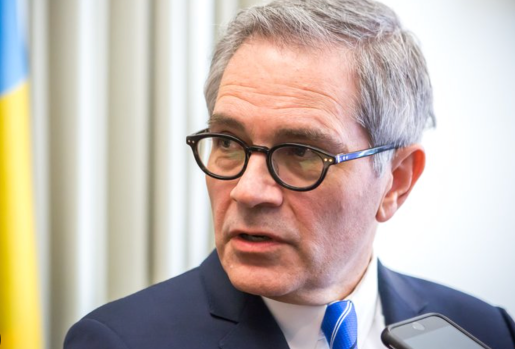
Philadelphia DA Larry Krasner and the Local Prosecutor’s Role in Defending the Republic

Excerpt: Philadelphia District Attorney Larry Krasner is not just fighting over policy. He is making a deeper rule-of-law argument: federal power must remain lawful power, and local officials have a duty to act when constitutional limits are crossed. Would you like your prosecutor to join this initiative?
There is a familiar way to talk about Philadelphia District Attorney Larry Krasner: progressive prosecutor, reformer, polarizing figure, Trump antagonist.
All of that is true enough. But it misses the more important story.
Krasner is becoming a case study in a question every democracy must answer sooner or later:
When national power starts pushing past legal limits, who is still willing to say no?
That question is not abstract. Krasner has joined with other elected prosecutors in a national effort called the Project for the Fight Against Federal Overreach, or F.A.F.O., aimed at holding federal officials accountable when they allegedly violate state law. The Philadelphia District Attorney’s Office says the coalition was formed amid concerns about warrantless entries, unlawful detentions, and coercive tactics by federal agents, especially where federal agents are being surged into local communities.
Krasner’s core message is simple: “No agency or officer is above the law.” He argues that when federal agents exceed lawful authority, local prosecutors have both the power and the duty to act through lawful institutions.
That is the sentence worth sitting with.
Because in a constitutional republic, “law and order” cannot mean obedience to whoever currently controls the White House. It must mean obedience to law.
Why Krasner matters
Krasner is not a neutral figure in American politics. He was first elected in 2017 on a criminal justice reform platform. He opposed the death penalty, cash bail, mass incarceration, and the prosecution of many minor nonviolent offenses, while promising to hold police accountable. He has been attacked for years by Donald Trump and other Republicans, survived an impeachment effort by Republican state lawmakers, and won Philadelphia’s 2025 Democratic primary for a third term.
So no one should pretend that Krasner floats above politics.
But that is exactly why his current role is important.
Democracy is not defended only by saints, judges, scholars, or people whose tone everyone likes. It is defended by officeholders with actual power, actual constituencies, and actual legal authority, who are willing to use that authority when the moment requires it.
Krasner’s argument is not that Philadelphia can nullify federal law. It is not that local prosecutors can block every immigration operation they dislike. And it is not that federal officers should be presumed guilty.
His argument is narrower, stronger, and more constitutional:
Federal officers do not get a blank check to commit state crimes simply because they work for the federal government.
That matters.
The pardon problem
One reason this issue is so important is the presidential pardon power.
The Constitution gives the president power to pardon “Offences against the United States.” That means federal crimes. It does not mean state crimes. Cornell’s Legal Information Institute summarizes the rule plainly: the president’s pardon power extends only to federal offenses, not state crimes or civil wrongs.
That creates a real constitutional safeguard.
If a president encourages federal agents to break the law and then promises federal pardons, state prosecution may be one of the few remaining tools that can still reach misconduct. Lawfare has made this point directly: state prosecutions of ICE agents could end up in federal court, but any conviction for a state offense would remain beyond the president’s pardon power.
This is not a loophole. It is federalism doing one of the jobs federalism was designed to do.
The American system divides power because concentrated power is dangerous. States are not merely administrative units of the federal government. Cities and counties are not merely branch offices of Washington, D.C. Local prosecutors are elected officials with duties to their own communities and to state law.
When that structure works, it can slow authoritarian momentum.
The limits matter too
The rule-of-law case for Krasner’s approach is strongest when it is disciplined.
Federal officers do have protections when they are lawfully doing their jobs. The doctrine often called Supremacy Clause immunity can protect federal officials from state prosecution when they are reasonably acting within the scope of lawful federal duties. But that protection has limits. Legal scholars at the State Democracy Research Initiative summarize the basic rule this way: states may prosecute federal officials for state crimes, but not when the prosecution is merely an effort to undermine lawful federal policy; prosecutions may proceed when federal officials act beyond their duties, violate federal law, or behave in an egregious or unreasonable way.
That distinction is crucial.
A democracy cannot survive if local officials can sabotage lawful federal authority whenever they disagree with federal policy.
But a democracy also cannot survive if federal officers can trespass, assault, falsify evidence, unlawfully detain people, or kill without accountability simply by invoking a badge.
The constitutional answer is not “federal power always wins.”
The answer is: lawful federal power wins, and unlawful conduct remains answerable to law.
Protest, immigration, and the First Amendment
Krasner has also framed this issue around protest rights.
In June 2025, before a Philadelphia “No Kings” protest against President Trump and his policies, Krasner encouraged people to peacefully demonstrate and said his office would protect their right to do so. He also warned that consequences would apply both to opportunists who used protest as cover for crimes and to ICE agents who went beyond what the law permits.
That is the right frame.
The First Amendment does not belong only to citizens whose politics the government likes. It does not disappear because the protest is about immigration. It does not disappear because the president finds the protest insulting.
At the same time, protest is not a license for violence.
A serious prosecutor has to protect both truths at once: the right to dissent and the duty to keep people safe.
That balance is where rule-of-law leadership lives.
What Krasner and prosecutors like him can do
Krasner’s example points toward a practical playbook for local democracy defense.
First, prosecutors can make the law visible. Authoritarian politics often works by confusion: people are told that federal agents can do whatever they want, that no one can question them, that ordinary constitutional limits have been suspended. A local prosecutor can calmly explain: no, there are rules; no, a badge is not a magic wand; no, a presidential pardon does not erase state criminal liability.
Second, prosecutors can build coalitions before crises hit. The F.A.F.O. coalition says it will share strategies, provide public updates, educate the public about legal pathways, and coordinate accountability efforts across jurisdictions. That kind of preparation matters. The worst time to invent a rule-of-law response is after the crisis has already begun.
Third, prosecutors can create deterrence. The point is not to prosecute every federal agent. The point is to make unlawful conduct less likely. If federal officers know local evidence will be preserved, local prosecutors are watching, and unlawful violence or coverups may lead to charges, that knowledge may prevent abuse before it happens.
Fourth, prosecutors can protect evidence. In clashes between federal force and local communities, video, witness statements, medical records, dispatch logs, body-camera footage, and local police records may become crucial. Local prosecutors can help ensure evidence does not disappear into bureaucratic fog.
Fifth, prosecutors can draw bright lines. They can say in advance which conduct will trigger scrutiny: assault, unlawful entry, unlawful detention, obstruction, witness intimidation, evidence tampering, false statements, impersonation, and civil-rights violations where state law allows prosecution.
Sixth, prosecutors can respect due process even for people they condemn. This may be the most important test. The rule-of-law answer to government overreach cannot be mob justice in local clothing. If federal agents are accused of crimes, they deserve evidence-based charging, fair process, and the presumption of innocence.
That is not weakness. That is the difference between democracy and revenge.
The bigger lesson
Larry Krasner is not the whole story. He is one example of a larger democratic principle.
When federal power is used lawfully, local officials should not obstruct it merely because they dislike the policy.
But when federal power is used unlawfully, local officials should not hide behind politeness, fear, or institutional habit.
They should act.
That is especially true in cities like Philadelphia, where American constitutional democracy is not a museum exhibit but a living inheritance. The Declaration of Independence and the Constitution are not just old documents behind glass. They are instructions for moments like this.
- No kings.
- No secret police.
- No presidential get-out-of-jail-free card for state crimes.
- No officer above the law.
Krasner’s tone will not be for everyone. Some people will hear too much combativeness in it. Some will distrust his criminal justice record. Some will say local prosecutors should stay far away from fights with Washington.
But the deeper question is not whether one agrees with every Krasner policy or every Krasner phrase.
The question is whether we still believe in a constitutional republic where power is divided, law binds government, and local officials have a duty to protect their people when national authority becomes abusive.
If the answer is yes, then Krasner’s example deserves attention.
Not as hero worship.
As a reminder.
Democracy does not defend itself.